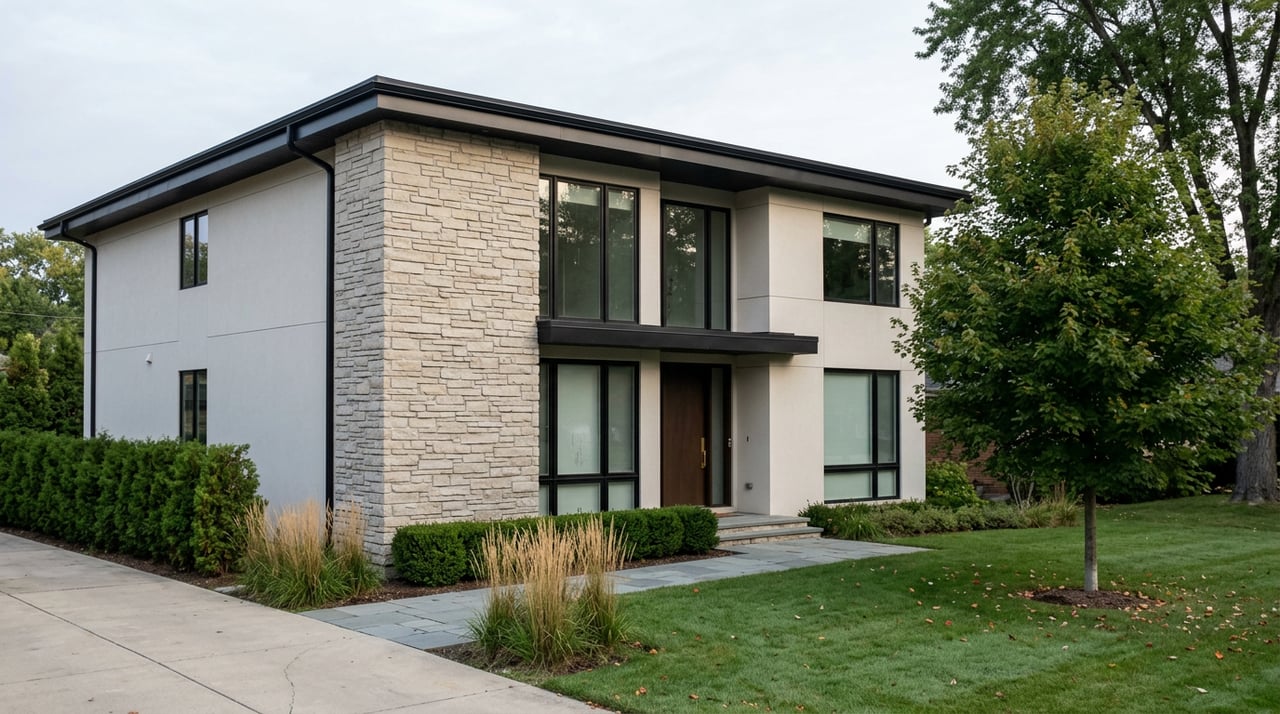
On April 1, 2026, the Hinsdale Historic Preservation Commission sat through a public hearing on a modest request: tear down a 115 year old Colonial Revival home at 305 S. Garfield St. and replace it with something new. Commission chair John Bohnen didn't like the design at first. He liked the underlying trend even less. "Many of us are concerned that, at some point in time, we're going to lose the designation as a historic district, because there's going to be very little left that emulates historic architecture," he said. Then the commission approved the demolition and the new build, 5 to 0.
That single vote is a smaller version of what's happening across the entire Hinsdale market in 2026. The village's headline detached median, $1.55 million over the trailing twelve months through June, reads like a story about demand. Compare it to nearby Oak Brook, which has no Metra station, or Burr Ridge, and the premium looks like it's just paying for a train stop and a school district. It isn't only that. Underneath the median is a quieter argument about what a Hinsdale house is actually worth once you separate the structure from the dirt it sits on, and nowhere is that argument louder than in the Robbins Park Historic District, where preservation and land value have been colliding for close to two decades.
The Number That Describes An Average, Not A House
Start with the gap most portals don't explain. Trailing twelve month MLS data through June 2026 puts the Hinsdale detached median at $1.55 million, up 6.9 percent year over year, while the average sale price for the same period sits at $1.76 million, up 4.8 percent. That $200,000 spread exists because Hinsdale is a low volume market. A handful of estate sales above $3 million pull the average well above the median every single reporting period, which means the "typical" Hinsdale home and the "average" Hinsdale home are two different numbers describing two different tiers of buyer.
There's a second gap worth sitting with. Zillow's home value index, which tracks estimated value across the entire housing stock rather than just recent closings, put the typical Hinsdale home around $1.0 million as of June 2026. That's roughly half a million dollars below the median sale price of homes that actually changed hands in the same window. The difference isn't a data error. It's a signal that what's transacting right now skews toward the newer, rebuilt, or recently updated slice of the market, while the broader stock of older homes, the ones not currently for sale, is quietly worth less. In a market this size, the median doesn't describe the average house in Hinsdale. It describes the subset of houses currently changing hands, and that subset is not representative.
Two Markets Sharing One Zip Code
The detached and attached segments aren't points on a spectrum. They're two separate markets that happen to share a zip code.
| Segment | Trailing 12-mo median (through June 2026) | Year-over-year change |
|---|---|---|
| Detached single-family | $1,550,000 | +6.9% |
| Attached (condo/townhome) | $633,875 | +9.3% |
A buyer priced out of detached Hinsdale doesn't find a cheaper detached tier the way they might in a larger suburb. They find condos and townhomes, most of them clustered near the downtown Metra core, running less than half the detached median. That's not a gradual ladder. It's a cliff, and it means the "entry point" conversation in Hinsdale is really a conversation about attached product, not about finding a smaller single-family house.
What Robbins Park Is Actually Telling You
If you want to see where land value overtakes structure value in plain sight, look at Robbins Park. The subdivision, bounded by Chicago Avenue, 8th Street, County Line Road, and Garfield Street, was listed on the National Register of Historic Places in 2008. At the time, 65 percent of its 475 homes were classified as significant or contributing to the district's historic character. By 2024, village reporting put the number of homes already lost to demolition at roughly 30, a pace that hasn't reversed since.
Village community development director Robb McGinnis has watched the volume shift over his tenure. In 2024 he noted the village had processed 26 permits for new homes villagewide the previous year, down from something closer to 120 in his first year on the job. The overall pace has cooled. What hasn't cooled is the specific pull toward Robbins Park, where older homes on generous, well-located lots keep getting valued for what a builder can put on them rather than for what's already standing.
The village has tried to slow that math down without stopping it. In 2024, trustees raised the demolition fee for homes in Robbins Park from $7,928 to $11,100 and created a new Ad Hoc Historic District Design Review Team that property owners must meet with before they can even apply for a certificate of appropriateness. None of it is a veto. As Village President Tom Cauley put it at the time, the process is designed to encourage preservation, but "at the end of the process, which will be completed in a reasonable length of time, homeowners can do what they want with their properties, no matter what the HPC and board may decide." The commission can ask for changes. It can't stop a demolition it disagrees with.
The losses that draw the most attention aren't hypothetical. The Whitney House at 142 E. First St., a 156 year old Italianate home and the first property in Hinsdale ever placed on the National Register, was torn down and is being replaced with what local reporting describes as a multi-million dollar new build. That's the version of "land value beats structure value" that shows up in a village newsletter, not just a spreadsheet.
The Village's Counteroffer
Not every recent decision has gone toward demolition. At a March 26, 2026 meeting, the Historic Preservation Commission approved a request for alternative bulk zoning, a building permit fee waiver, and an expedited process for a property owner choosing to preserve rather than rebuild. Commissioners also recommended the village board approve a property tax rebate worth about $5,160 spread over five years and a $10,000 matching construction grant, with a board vote scheduled for the following meeting.
That package matters for anyone weighing a Hinsdale purchase against a renovation plan. The incentives are real but modest against a market where teardown lots alone can run into seven figures. They tell you the direction the village wants owners to lean, not the direction the market is actually pulling them.
What This Means If You're Touring Right Now
Before you assume a lot supports the home you want to build, or that an older house is a straightforward renovation, a few zoning basics change the math from block to block. Hinsdale's single-family districts run from R-1 to R-4, with minimum lot areas ranging from 30,000 square feet down to 10,000, minimum lot widths between 70 and 125 feet, a 35 foot front yard requirement in every district, and a lot coverage cap of 50 percent. Front yard setbacks can be averaged against neighboring developed lots, which is exactly the kind of detail that changes what's buildable on a given parcel.
If demolition is part of the plan, the process has a fixed timeline no matter where the property sits:
- File for a demolition permit with the village.
- Notify adjacent residents within 250 feet of the property.
- Wait a minimum of 30 days after the notice certification is filed before the village can issue the permit.
- If the property is in Robbins Park or the downtown historic district, file a preliminary application and attend a design review meeting with the Ad Hoc Historic District Design Review Team before a certificate of appropriateness can even be requested.
That fourth step is the one buyers underestimate. It doesn't block a project. It adds real weeks, sometimes months, to a timeline that a buyer elsewhere in the village wouldn't face at all.
Why The Land Costs This Much In The First Place
None of this happens in a market that isn't already paying a premium for what Hinsdale offers. The village sits directly on the BNSF Metra line, something neither Oak Brook nor Burr Ridge can offer, with a walkable downtown village both of those towns lack and a Hinsdale Central High School brand, part of District 86, that consistently ranks among the strongest public high schools in Illinois. Hinsdale also sits primarily in DuPage County, which carries a lower property tax rate than the Cook County side of comparable towns like Riverside or Western Springs. Put those together and you get a base premium over Oak Brook's roughly $950,000 to $1.1 million detached range and Burr Ridge's roughly $1.0 to $1.25 million range before land economics ever enter the conversation. The teardown pressure in Robbins Park isn't happening because Hinsdale is expensive. It's happening because Hinsdale was already expensive, and a builder can now extract more value from a well-located lot than from the house on top of it.
A Few Questions Worth Asking Before You Tour
Does buying in Robbins Park mean I need historic preservation approval just to renovate? Not automatically. Interior work and most exterior repairs don't trigger review. Demolition, new construction, and relocation of a residence within the district do, along with any change to a home already on the village's landmarked list.
What happens if the commission denies a demolition request? The commission's opinion is advisory. A denied certificate of appropriateness doesn't stop a homeowner from proceeding, though it can add time, design conditions, and cost through the required design review step.
Is the real entry point to Hinsdale actually $1.5 million? No. That figure describes the detached median. The attached segment, condos and townhomes concentrated near downtown, has a trailing twelve month median under $650,000, and it's the more realistic starting point for buyers who want Hinsdale's schools and walkability without competing in the detached tier.
If you're weighing a Hinsdale purchase against the timeline and cost of a teardown, or trying to figure out what a specific lot in Robbins Park or downtown actually allows, that's exactly the kind of question worth working through before you write an offer. Our guide to buying a home in Hinsdale covers the basics, but every lot is different. Envision Homes Now works these transactions block by block. Schedule a free consultation and we'll walk through what a specific address can and can't support before you're locked into a timeline you didn't plan for.
